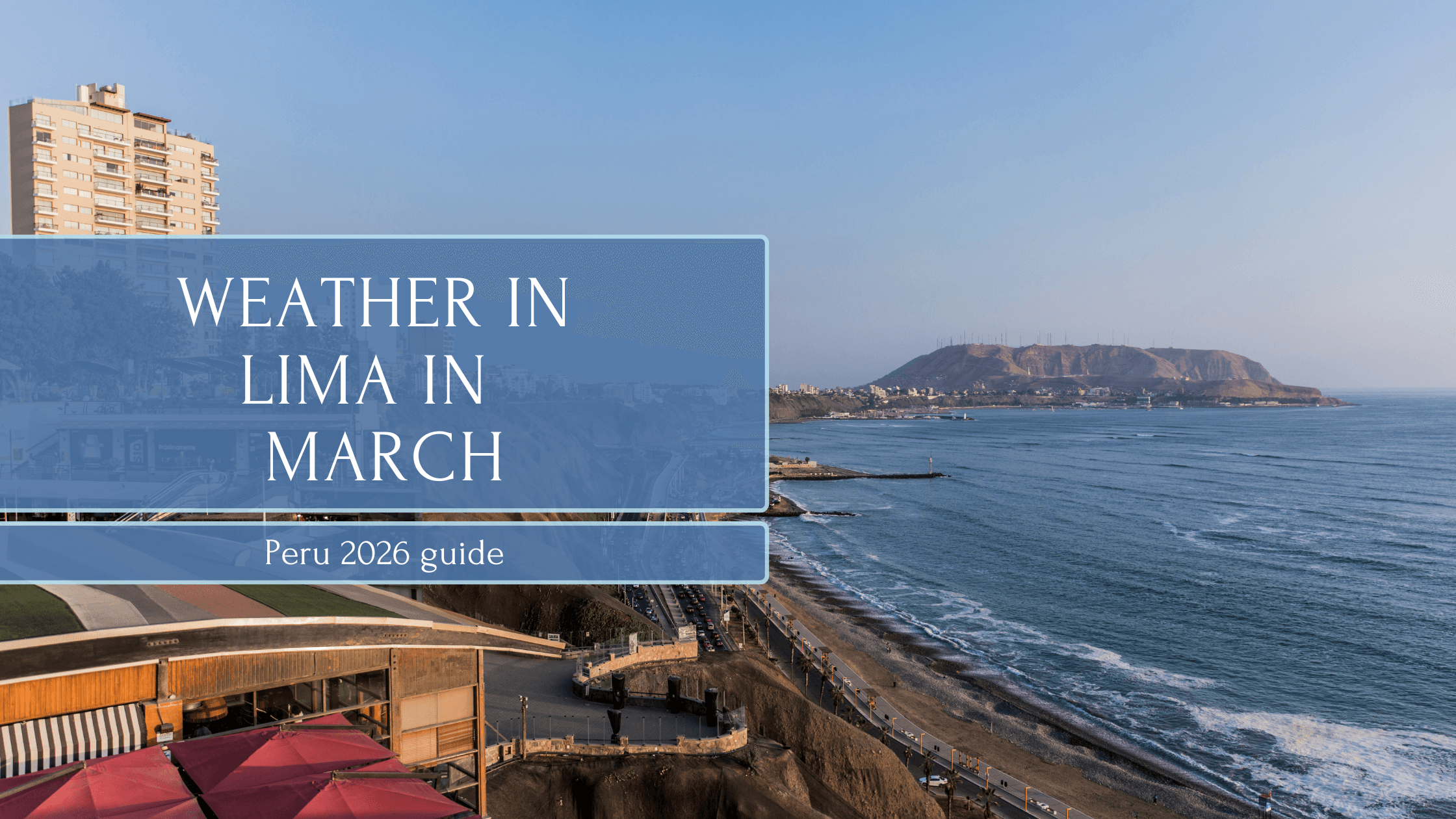
Weather in Lima, Peru in March
Weather in Lima, Peru in March
March is one of Lima’s warmest months — the tail end of summer on the Peruvian coast. The city sits in a subtropical desert climate shaped by the cold Humboldt Current, which means even in its hottest month, Lima rarely swelters. Expect warm, hazy days with coastal cloud cover, minimal precipitation, and evenings that stay comfortable. If you’re deciding whether the weather in Lima in March works for your trip, the short answer is yes — with a few caveats.
This month suits travelers who want good weather and average temperatures without peak-season crowds or prices. It’s a solid fit for couples, first-time visitors, and food-focused travelers. It’s less ideal if you’re chasing blue skies — Lima’s overcast mornings are a year-round reality, and March is no exception. Weather in Peru in March varies significantly depending on the region, so travelers combining Lima with Machu Picchu or the highlands and jungle should plan carefully, as those areas are still deep in the wet season. If you’re also figuring out where to stay in the capital or beyond, check out this guide on where to stay in Lima for neighborhood-by-neighborhood options.
Quick Weather Snapshot
- Average high: 25°C (77°F)
- Average low: 21°C (70°F)
- Rainfall / Precipitation: Low — approximately 3mm total for the month, around 5–6 rain days
- Humidity: Moderate to high — averaging 76–89% relative humidity
- Season: Late summer / shoulder season onset
- Cloud cover: Frequent morning overcast; clearer afternoons
- Crowd level: Low to moderate — shoulder season pricing and fewer tourists
- Overall comfort rating: 7/10 — warm and walkable, but humid and often gray
What Lima Is Like in March: Peru Weather on the Coast
March in Lima feels warm and slightly hazy. The city is transitioning out of its brief summer peak, and while temperatures remain high, the oppressive heat of January and February has already softened. You’ll notice Lima’s signature coastal fog — known locally as garúa — most often in the mornings, though it typically lifts by midday.
Afternoons are the best window for outdoor sightseeing. The Malecón clifftop walkways, Miraflores parks, and Barranco’s streets are all pleasant in the afternoon warmth. Evenings are comfortable enough to dine al fresco without a jacket. Walking and exploring the city on foot is easy — rain rarely disrupts plans for more than an hour or two. If you’re wondering what the weather is like in Peru in March overall, Lima during March sits at the warm, dry end of the spectrum — a strong contrast to what you’d find in the Inca heartland or the Amazon basin.
Average Daily Temperatures in Lima in March
Daytime highs sit around 25°C (77°F), occasionally nudging toward 27°C (81°F) in warmer years. The low temperature at night cools modestly to around 20°C–21°C (68–70°F) — warm enough that you won’t need layers. The average daily range is narrow by global standards, typical of Lima’s coastal desert climate. Sun exposure is moderate but consistent in the afternoons; UV index readings are elevated, so sunscreen matters even on cloudy days.
Compared to April, March is noticeably warmer. Compared to February — Lima’s hottest and most humid month — it’s nearly identical in average temperature, though humidity begins to ease slightly. If you’re sensitive to heat, afternoons between noon and 3pm are the most uncomfortable window. The hourly temperature curve peaks around 2–3pm before coastal breezes arrive to break the heat.
Precipitation in Lima in March
Lima is one of the driest capital cities on Earth, and march weather reflects that. Rainfall totals are minimal — around 3mm accumulated across the month, typically spread over 5–7 days of light drizzle. The chance of rain on any given day in March is low. What does fall is usually a brief mist rather than a downpour — storms are rare along the coast.
Rain in Lima almost never disrupts a full day’s plans. If anything, a morning drizzle often clears out by 10am. There’s no real need to build your itinerary around rain patterns; precipitation simply isn’t a significant factor this month. This is one reason coastal Peru — and Lima specifically — appeals to travelers visiting Peru in March when the highlands are still in the wet season.
Humidity in Lima in March
This is the one weather factor worth paying attention to. Relative humidity in March averages around 76–83%, which is noticeable but not tropical-level oppressive. The conditions are best described as warm and humid — not hot and humid in the way the Amazon jungle can be, but muggy enough to slow you down at midday. Combined with warmth, it creates a heavy feel before coastal breezes arrive.
Travelers who find humidity tiring should plan heavier activity — long walks, museum visits, market days — for mornings or evenings rather than midday. Lima’s sea breeze usually arrives by mid-afternoon and cuts through the heat considerably. Average wind speed in March sits around 9 mph (14.7 kph) — mild and consistent, which helps. Those arriving from high-altitude Andean cities like Cusco or Arequipa may find the coastal humidity jarring at first.
Is Lima Busy in March? (Tourism Levels)
March is generally considered a shoulder season in Peru, with fewer tourists around. Lima is less affected by peak-season swings than Cusco or Machu Picchu, but you’ll still notice lower hotel rates and easier restaurant reservations compared to July or August. Major attractions like Larco Museum, Huaca Pucllana, and the Miraflores boardwalk see manageable visitor numbers.
There are no major Lima-specific holidays or festivals in March that spike crowds or accommodation prices. School holidays in Peru don’t fall in March, which keeps family group tourism lower. Budget travelers benefit from better availability and more competitive pricing on both flights and hotels. The period from May to September is Lima’s peak for international visits — March sits comfortably outside that window.
Best Time to Visit Peru: Where Does March Rank?
Understanding the best time to visit Peru requires splitting the country by region, since weather conditions vary dramatically from coast to highlands to jungle.
- Coastal Lima and Paracas: The best times to visit are December to March, when the weather is warm and dry along the coast. March marks the final stretch of that window — a good time to enjoy the beach at Paracas and see the Ballestas Islands before the gray chill sets in.
- Cusco, Sacred Valley, and the Inca Trail: March sits near the end of the rainy season in the highlands. Trekking routes to Machu Picchu are still wet and the Inca Trail may have restricted access. Conditions become more favorable from April onward.
- Arequipa and Colca Canyon: March is near the end of the wet season for the southern highlands, though weather improves through the month. Expect lush landscapes and occasional afternoon rain.
- Amazon and Jungle: Hot and humid year-round, with March falling in the wettest period — rivers are high, which can make certain lodge access easier but jungle treks harder.
- Lake Titicaca and Puno: March sits near the end of the wet and rainy period for this region.
For a visit to Peru that centers on Lima and coastal Peru, March is one of the best times. For highlands-focused itineraries, it’s the end of the rainy season — manageable but not ideal. November to March is generally Lima’s warm-weather window. Time to visit Peru also depends on budget: shoulder season in March means better rates across the board.
Best Things to Do in Lima in March
- Walk the Malecón Cisneros in Miraflores — the clifftop promenade is at its best in March warmth, especially late afternoon
- Visit Larco Museum — one of the world’s great pre-Columbian and Inca collections; covered and comfortable regardless of weather
- Day trip to Paracas and the Ballestas Islands — warm March conditions make this one of the best times to enjoy the beach and wildlife reserve along the coast
- Explore Barranco on foot — Lima’s bohemian coastal neighborhood is compact, walkable, and full of food and art
- Eat your way through the city — March is ideal for Lima’s world-class restaurant scene; book Maido, Central, or Kjolle well in advance
- Day trip to Pachacámac ruins — the ancient Inca-era adobe complex south of the city is best explored in March’s moderate heat
- Visit the Museo de Arte de Lima (MALI) — a solid indoor backup on overcast mornings
- Catch a sunset from Larcomar — the clifftop open-air mall offers reliable views as skies often clear in the evening
Events & Festivals in March
There are no large-scale Lima-specific festivals in March. Cajamarca Carnival, one of Peru’s most colorful annual celebrations, takes place in early March — but in the northern highlands city of Cajamarca, not Lima. It’s worth noting if you’re considering adding a northern Peru leg to your trip.
Lima in March is quiet by Peruvian festival standards. Neighborhood food markets and weekend cultural events do occur throughout the month, but none are must-plan-around occasions. Check Lima’s local events calendar closer to your travel date for anything spontaneous.
What to Pack for Lima in March
Clothing
- Lightweight, breathable tops (linen or cotton)
- One light layer or long-sleeve shirt for morning cloud cover and air-conditioned restaurants
- A packable, light rain layer — not for heavy rain, just drizzle
Footwear
- Comfortable walking shoes with grip — Lima’s coastal districts involve a lot of sidewalk and stair-climbing
- Sandals for warmer afternoons and beach days
Sun & Rain Protection
- SPF 50 sunscreen — UV levels are high even under cloud cover
- Sunglasses
- A compact umbrella or packable poncho (optional — rarely needed but worth having)
Other
- Reusable water bottle — staying hydrated matters in humidity
- Light day bag for street markets and long museum days
Seasonal Travel Tips: Planning Your Trip to Lima in March
- Go out early or late. Midday (noon–3pm) is the muggiest and least comfortable time to walk long distances. Morning and late afternoon are the sweet spots.
- Expect gray mornings. Lima’s coastal fog is not a weather anomaly — it’s structural. Don’t let it alter your plans; it typically lifts by 10–11am.
- Book top restaurants ahead. Lima’s best restaurants are world-renowned and often fully booked weeks in advance regardless of season.
- Bring layers into air-conditioned spaces. Malls, museums, and restaurants in Lima tend to run their AC aggressively; a light shirt over a tee goes a long way.
- March 1 is a useful planning anchor. If you’re building a multi-week Peru itinerary, arriving in Lima at the start of March gives you the warmest coastal conditions before highland trails begin to dry out by late April.
- Separate your highland and coastal packing. What works in Lima in March doesn’t work around Machu Picchu — rain gear and warm layers are still essential in the highlands. Peru in March varies enough by region that one bag rarely covers everything.
- Enjoy the beach while you can. This is one of the last months to reliably enjoy the beach in Lima and along coastal Peru before the cold Humboldt-driven chill sets in through the winter months.
Weather Hazards in Lima in March
Lima in March presents minimal weather hazards for most travelers.
- No significant storm risk. Lima receives almost no measurable rain in March; flooding is not a concern for the city itself.
- UV exposure. Despite frequent cloud cover, UV radiation at Lima’s latitude can be deceptively strong. Unprotected midday exposure can cause sunburn faster than expected.
- Humidity fatigue. The combination of 76–89% humidity and 25°C heat can tire travelers who are not acclimatized — especially those arriving from cool climates.
- No altitude concern in Lima. The city sits at sea level. Altitude is only a factor if you’re continuing to Cusco (3,400m), Arequipa (2,300m), or areas around Machu Picchu (2,430m).
- El Niño years. In strong El Niño years (historically 1983, 1998), Lima can experience anomalously high temperatures and unusual rainfall. These are rare events — standard March conditions are significantly milder.
Key Takeaways
- Weather in Peru in March varies sharply by region — Lima and coastal Peru are warm and dry, while the highlands and jungle remain in or near the end of the rainy season
- March in Lima sits at the tail end of the warm season — average high of 25°C (77°F), low temperature around 20–21°C (68–70°F)
- Precipitation is minimal; Lima is one of the driest capitals in the world and this travel guide confirms March is no exception
- Humidity averages 76–89% — noticeable but manageable with smart timing of outdoor activities
- It’s shoulder season, which means fewer crowds, lower hotel rates, and easier access to attractions
- Visiting Peru in March works best for coastal itineraries — Inca Trail trekkers should wait until April or later
- UV exposure is a real consideration even on cloudy days — sunscreen is essential
FAQs
Is March a good time to visit Peru?
It depends on where you’re going. Visiting Peru in March is ideal for Lima and coastal destinations like Paracas — the weather is warm, dry, and comfortable along the coast. For highland destinations like Cusco and the Sacred Valley, March is near the end of the rainy season, which means trekking routes are wetter and Inca Trail permits may be restricted.
What is the weather like in Peru in March?
Peru weather in March varies significantly depending on the region. Lima and coastal Peru experience warm, low-precipitation conditions with average temperatures around 25°C (77°F). The highlands — including Cusco, Arequipa, and areas around Machu Picchu — are still in the wet season with regular afternoon rain and cooler nights. The jungle is hot and humid, with March falling in its wettest period.
Does it rain a lot in Lima in March?
No. Lima averages only about 3mm of total rainfall in March across roughly 5–6 days of light drizzle. The chance of rain on any given day in March is low, and showers are brief and rarely affect full-day plans. This is one of the driest months of an already very dry city.
What should I wear in Lima in March?
Lightweight, breathable clothing is ideal for the warm days. Bring a light layer for air-conditioned spaces and morning cloud cover. Sunscreen and sunglasses are essential — UV levels are high even when skies appear overcast.
Is March part of Lima’s dry season or rainy season?
Lima’s climate is uniquely arid year-round, making “rainy season” a relative term. March falls in the city’s warm summer period and is among its drier months. The end of the wet season for the Peruvian highlands typically arrives in April or May — for Lima, the concept barely applies. December to March is the city’s warm and dry window, making it the best time to visit for beach weather and comfortable outdoor exploration.